InDutch
Started September 2026 · Backend live, preparing public launch at indutch.app
A native iOS and Android Dutch vocabulary trainer with FSRS-6 spaced repetition (the “new Anki algorithm”), and a Go backend serving 15,600+ neural audio clips.
- FSRS-6 scheduling
- Native iOS & Android
- Passkey authentication
- Role
- iOS and Android apps, Go backend, content pipeline
- Stack
- SwiftUI
- Kotlin
- Jetpack Compose
- Go
- Echo v5
- PostgreSQL 18
- sqlc
- OpenAPI
- Astro
- Svelte
- React
- FreeBSD
What?
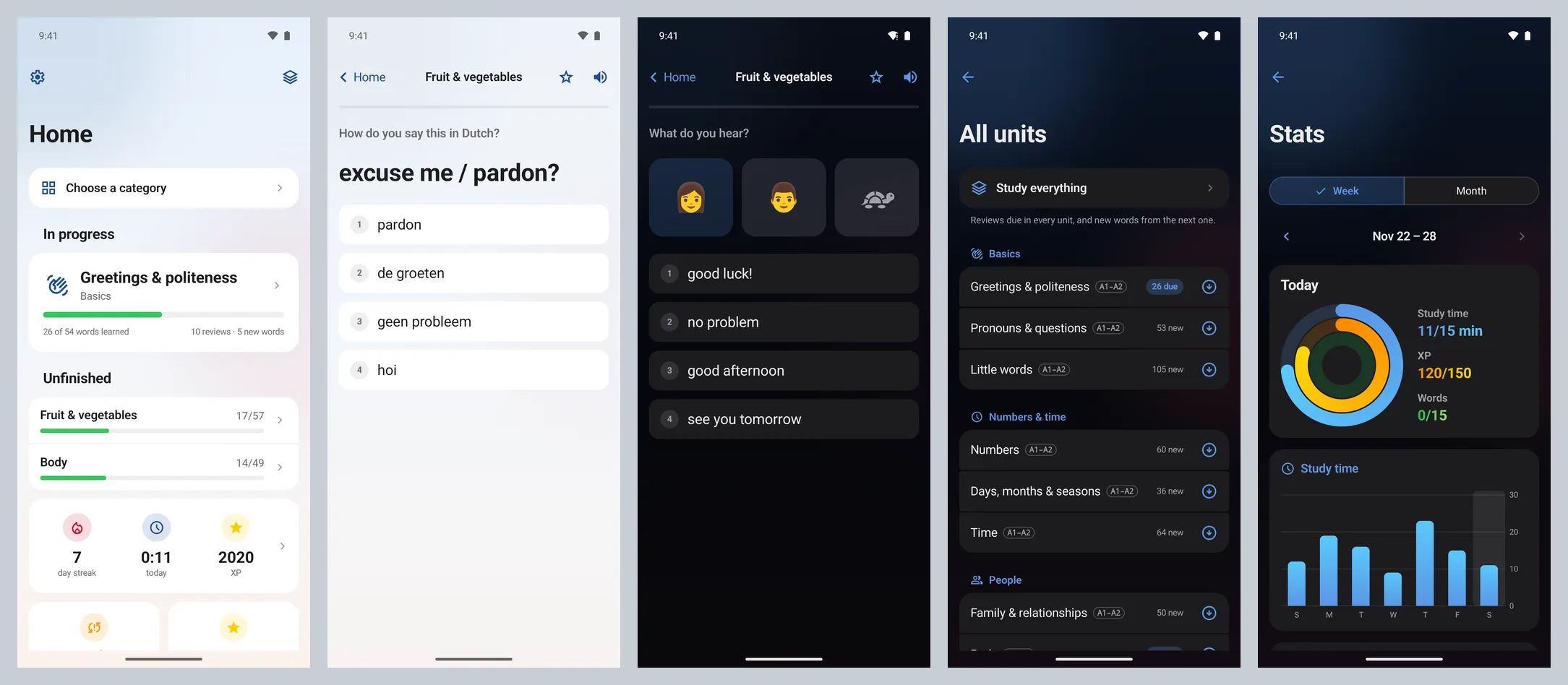
InDutch (called 荷理學 / Hélǐxué in Chinese, and heading toward a public Play Store release at indutch.app) is a Dutch vocabulary app for iPhone, iPad, and Android. The project spans four repositories: a SwiftUI app, a Kotlin / Jetpack Compose app with feature parity, a Go backend, and a static landing page.
The catalog currently has 14 categories, 58 decks, and 2,689 cards. Each card has English and Traditional Chinese (Taiwan) translations, a CEFR level, an IPA transcription, neural audio, and an example sentence for most entries.
Why?
I wanted a Dutch vocabulary trainer with both English and Traditional Chinese translations that didn’t ask learners to manually grade their own flashcards like Anki does. Building the iOS and Android apps side by side against the same backend also gave me a real project to take both SwiftUI and Jetpack Compose all the way from data modeling to offline sync.
How?
Lessons and automatic grading
A lesson mixes up to ten due review cards (ordered by how overdue they are) with up to five new cards from the chosen deck. New words show up with pronunciation, an example sentence, and a picture for concrete nouns, then get drilled through meaning selection, word selection, listening, typing, tile-based sentence building, and pair matching.
Instead of asking users to rate their own recall, the app grades each answer as correct, almost correct, or wrong, and maps that directly to the FSRS ratings Good, Hard, and Again.
Cross-platform FSRS-6 scheduling
Review intervals are scheduled with FSRS-6. The algorithm is ported from py-fsrs to both Swift and Kotlin and tested against fixtures generated by py-fsrs, so the two apps compute identical intervals. Before starting the Android client, the Swift domain rules (answer grading and lesson construction) were captured as written specs so both platforms behave the same way.
Server-driven content pipeline
Neither mobile app bundles vocabulary data. Cards, audio, and images come from the backend and get cached locally, so fixing a typo or adjusting a translation reaches everyone without shipping an app update.
Cards live in TSV seed files compiled into a catalog by a Python build script, with permanent UUIDv7 IDs so on-device review history never breaks when content changes. IPA transcriptions are generated offline with espeak-ng and fixed by hand where Dutch trips up the synthesizer. Every word and example sentence is synthesized with three Azure neural voices, around 15,600 clips in total, stored on a CDN under immutable URLs so cached audio never needs revalidation. Pictures from stock libraries and Wikimedia Commons go through a small React and shadcn/ui admin panel that tracks author, license, and source for each image.
Mobile apps and backend
The iOS client targets iOS 16 so older iPads still work, which meant skipping the Observation framework and SwiftData. Android targets Android 13 and up. Decks can be downloaded for offline study, and progress syncs across platforms over a shared state-based protocol. Android UI regressions are checked with Roborazzi screenshot tests.
The backend is a static Go binary implementing an OpenAPI 3 contract on PostgreSQL 18, deployed behind Caddy on FreeBSD. Accounts consist of just a username and a passkey, with no passwords or email addresses. Usernames are encrypted at rest and looked up by an HMAC of the normalized name.